BEAUTY BIBLE · ONE SESSION
Does facial acupuncture work after one session? Based on Dingyan's long-term clinical experience, most people can notice a difference after a single session. However, “noticing a difference after one session” and “completing a more comprehensive adjustment” are not the same thing. Every face has a different underlying structure, pattern of muscle and fascial tension, daily condition, and desired direction, so the number of observations and treatment rhythm will not be identical for everyone.
Most people can notice a difference after a single session
The first session is more than a trial. It allows the physician to observe how your facial contours, expressions, muscles, and fascia respond. If you would like a more complete course of adjustment, the following rhythm provides a useful clinical starting point.
Begin with one complete assessment and treatment, then observe your own contour, expression, and tension response.
Dingyan's usual treatment phase averages once weekly for six consecutive sessions, with the needling focus adjusted after every response.
Once the condition becomes more stable, move into maintenance with periodic assessment based on daily life and renewed tension.
These are Dingyan's general clinical arrangements, not a fixed protocol that everyone must follow. The physician adjusts the actual number and interval according to facial condition and the response after each session.
Does facial acupuncture work after one session?
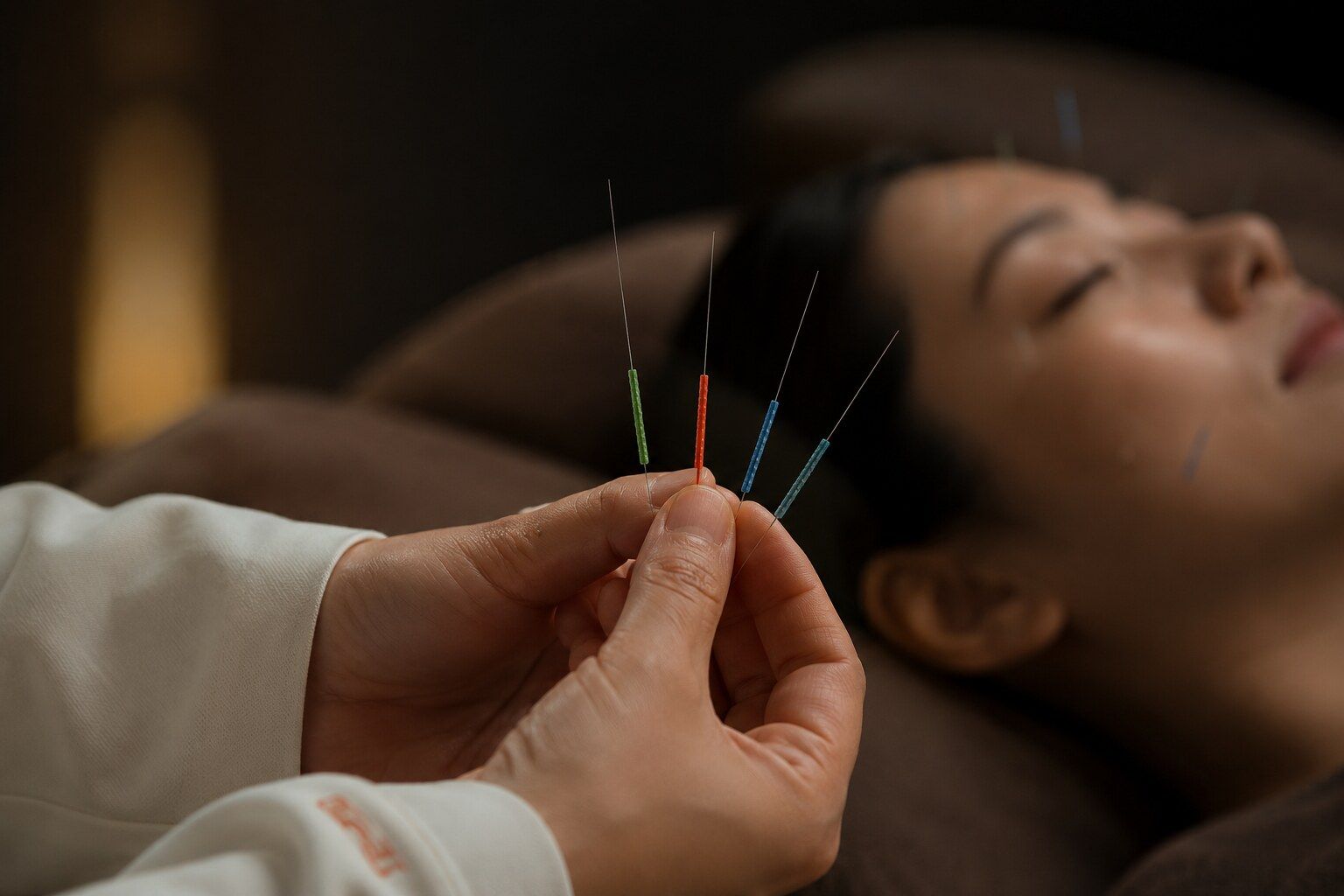
Based on Dingyan's long-term clinical experience, most people can notice a difference after a single facial acupuncture session. Some first notice a change in the jawline, left-right balance, or the way their expressions move. Some feel that chewing, the brow and eye area, the scalp, neck, or shoulders can relax more easily. Others first notice that the whole face looks more refreshed.
The first area and degree of change are different for every person. Facial appearance is simultaneously influenced by skeletal proportions, muscle use, fascial pull, puffiness, sleep, stress, posture, and daily habits. Facial acupuncture therefore does not produce exactly the same change in every person after one session.
What can be observed during the first facial acupuncture session?
The first session is not only an experience; it is also an important starting point for the physician's later decisions. Dingyan first clarifies the areas that matter most to you, then observes the response through resting contours, dynamic expressions, muscle tension, and the relationship between the face, head, and neck.
During a first session, you may be invited to look in a mirror after one side has been treated, comparing the contour, expression, and tension of the treated and not-yet-treated sides. This is not a promise of a fixed effect based on one image. It helps the physician and visitor observe that day's response together before completing the other side and the overall adjustment.
Why does noticing a difference once not mean the work is complete?
The face is used every day. Chewing, frowning, raising the eyebrows, speaking, sleeping position, breathing, and head-neck posture can all bring muscles and fascia back toward long-established patterns. Sleep loss, work stress, diet, and physical condition also affect puffiness, expression, and muscle tension.
Therefore, even when the first session produces a noticeable difference, accumulated habits may reappear. Follow-up care does not mechanically repeat the first needling pattern. The physician reassesses priorities based on the previous response and the condition on that day.
When Dingyan speaks of building the effect session by session, this does not mean assuming exactly the same amount of change each time. It means repeatedly observing, correcting, and integrating, so the face can gradually return to a more natural, coordinated, and stable state.
What is the purpose of six consecutive sessions?
In Dingyan's general clinical arrangement, when someone would like a more comprehensive adjustment, the treatment phase is usually once a week for six consecutive sessions. “Six sessions” is not a guarantee that everyone will reach the same result after the same number, nor does it mean mechanically repeating one treatment six times.
- Establish a response baseline: Understand how the face responds to different locations, directions, and tissue layers from before and after the first session.
- Adjust treatment priorities: Update the plan according to changes in contour, left-right tension, and daily condition.
- Observe different layers: The face, scalp, neck, and shoulders can pull on one another and may not all be addressed equally in a single session.
- Assess stability: Learn how long each change is maintained and which daily factors allow tension to accumulate again.
What is the difference between a single session, the treatment phase, and maintenance?
| Stage | Dingyan's general arrangement | Main purpose |
|---|---|---|
| Single session | One initial assessment and one complete treatment. | Observe the immediate response, experience, and appropriate treatment direction. |
| Treatment phase | Once a week for six consecutive sessions. | Repeatedly assess and adjust different layers to build a more complete plan. |
| Maintenance | About once every three to four weeks. | Provide periodic assessment and care according to daily circumstances and renewed tension. |
This is Dingyan's average rhythm under general circumstances, not a fixed schedule that everyone must follow. The physician adjusts the actual interval when the response, facial condition, daily schedule, or desired direction differs.
For more detail, read How Often Should You Have Facial Acupuncture?
What affects the experience of the first session?
Even for the same person, the face and body may not be in the same state at every visit. The first session should not be judged by one photograph or one area alone. The following factors need to be considered together:
- Underlying structure: Skeletal proportions, fat distribution, and skin support form the baseline of every face.
- Muscle and fascial tension: Long-term chewing, expression, and posture patterns affect contours and left-right balance.
- Puffiness and tissue condition: Sleep, food, and daily rhythm can change how heavy the face appears that day.
- Head, neck, and shoulder pull: The face does not exist in isolation; scalp, neck, and shoulder tension also influence expression and facial lines.
- Your desired direction: Prioritizing natural expression, a local contour, or an overall refreshed appearance changes the physician's treatment priorities.
The fairest comparison is your own condition before and after treatment, rather than using another person's photographs to predict the degree of change you will have after your first session.
How can international visitors plan facial acupuncture during a one-week stay?
For international visitors with limited time in Taipei, two to three sessions may be scheduled within one week after medical assessment, allowing a more concentrated course before departure. This is not simply a compressed version of the usual treatment phase. It is planned individually according to the length of stay, facial condition, and response after each treatment.
After the first session, the physician still needs to observe the response before deciding the next interval and priority. Please tell us before booking if your trip includes a flight, long-distance travel, filming or photography, or other aesthetic procedures.
Frequently asked questions about a single facial acupuncture session
Can I have only one session for my first visit?
Yes. You may begin with a medical assessment and one complete treatment, then discuss the next step based on before-and-after observation, personal needs, and the frequency you can realistically follow.
Will every concern improve after one session?
Not necessarily. The first session is a starting point for observing adjustable tension and tissue response. Skeletal proportions, fat volume, pronounced skin laxity, or changes caused by disease cannot be resolved by facial acupuncture alone.
Why do some people notice a strong difference while others notice something subtle?
Underlying structure, muscle and fascial tension, puffiness, electrolyte balance, and the main treatment goal all differ. These factors can influence how easily muscles tighten or relax, as well as the degree and duration of change. Another person's photographs cannot predict your response.
Do more needles create a stronger first-session result?
No. The important point is not the number of needles, but choosing the position, depth, direction, and sequence of each needle after assessment.
After six sessions, will I never need treatment again?
Not necessarily. Once the condition is stable, Dingyan's general maintenance rhythm is about once every three to four weeks. The actual frequency is adjusted according to daily circumstances, the speed at which tension returns, and individual needs.
How long does the condition after one session last?
There is no fixed number of days that applies to everyone. Sleep, stress, diet, muscle use, and physical condition all affect stability. Read How Long Do Facial Acupuncture Results Last?
Dr. Meng-Ying Lin|Founder and Medical Director of Dingyan TCM Clinic
Author of The Beauty Bible, Dr. Lin has long focused on facial acupuncture, facial muscles and fascia, lymphatic circulation, natural expression, and Eastern medical aesthetics. She developed the Dingyan Method by integrating skeletal proportions, muscle tension, fascial pull, and the whole-person perspective of Chinese medicine.
Content updated: July 29, 2026
This article provides general information about single-session response and treatment stages in facial acupuncture. It does not constitute an individual diagnosis or guarantee of results. Facial structure, muscle and fascial tension, physical condition, and appropriate treatment differ from person to person. The actual arrangement requires an in-person assessment by a qualified Chinese medicine physician or licensed acupuncture professional, as applicable locally.
Research and safety references: National Center for Complementary and Integrative Health; Facial Cosmetic Acupuncture Pilot Study. Research specifically focused on facial acupuncture remains limited, and preliminary findings should not be interpreted as a guarantee of individual results.
Your first visit can begin with an assessment and one complete treatment.
You do not need to decide on a long-term course in advance.
First observe that day's response, then discuss an appropriate follow-up rhythm with the physician.