
THE BEAUTY BIBLE · CLINICAL FOUNDATIONS
Professional manual work is not defined by how strong it feels. Before the hands move, the practitioner must understand where fluid should travel, which proximal pathways need preparation, and how fascial tension may change the route.
Two theories, two clinical questions
Dingyan draws on two complementary bodies of thought. Chikly-style lymphatic work asks where fluid should be guided and in what sequence. Anatomy Trains asks how tension in one region may influence movement elsewhere. They are not the same method, but together they improve clinical reasoning.
Chikly lymphatic drainage: direction, sequence and rhythm
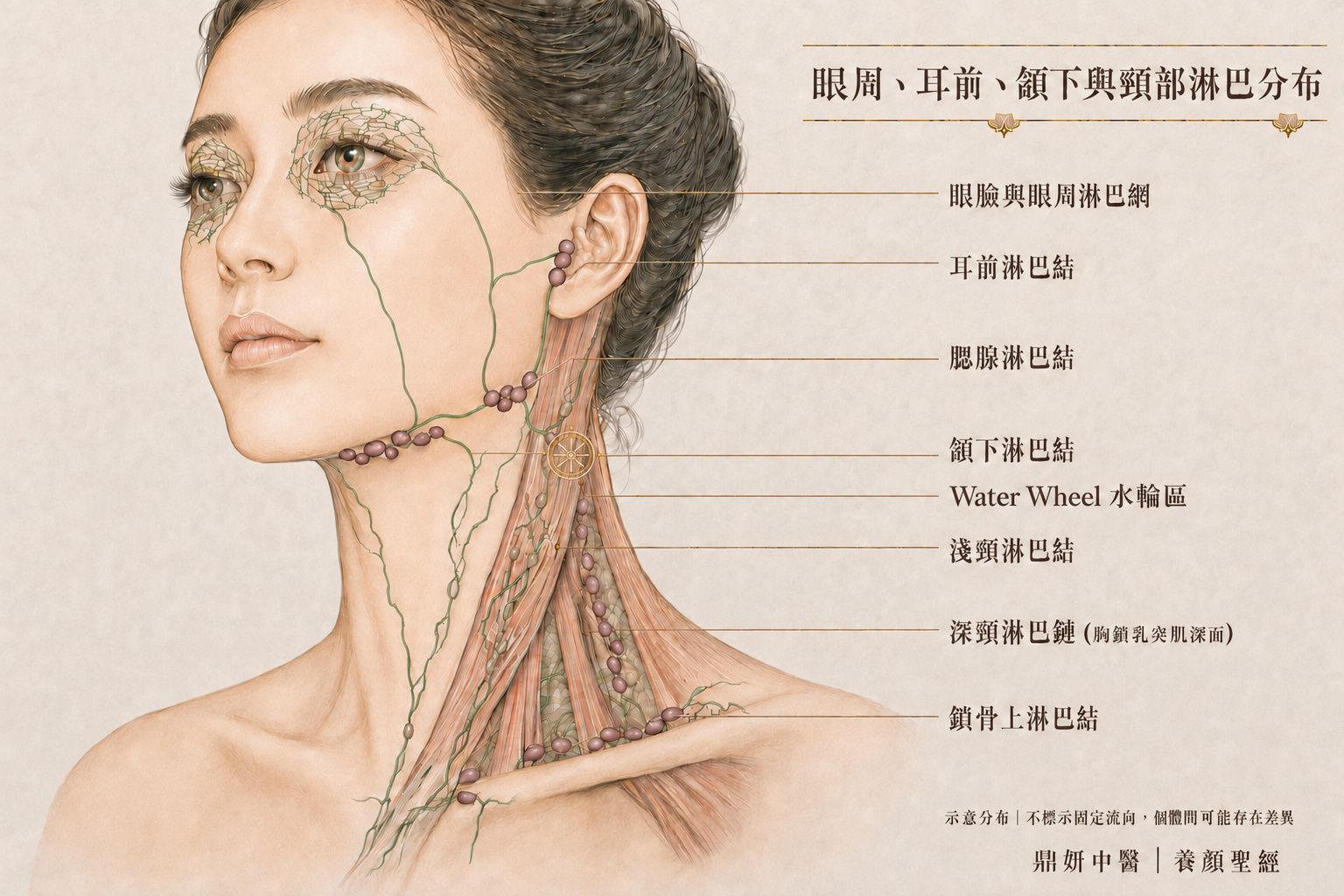
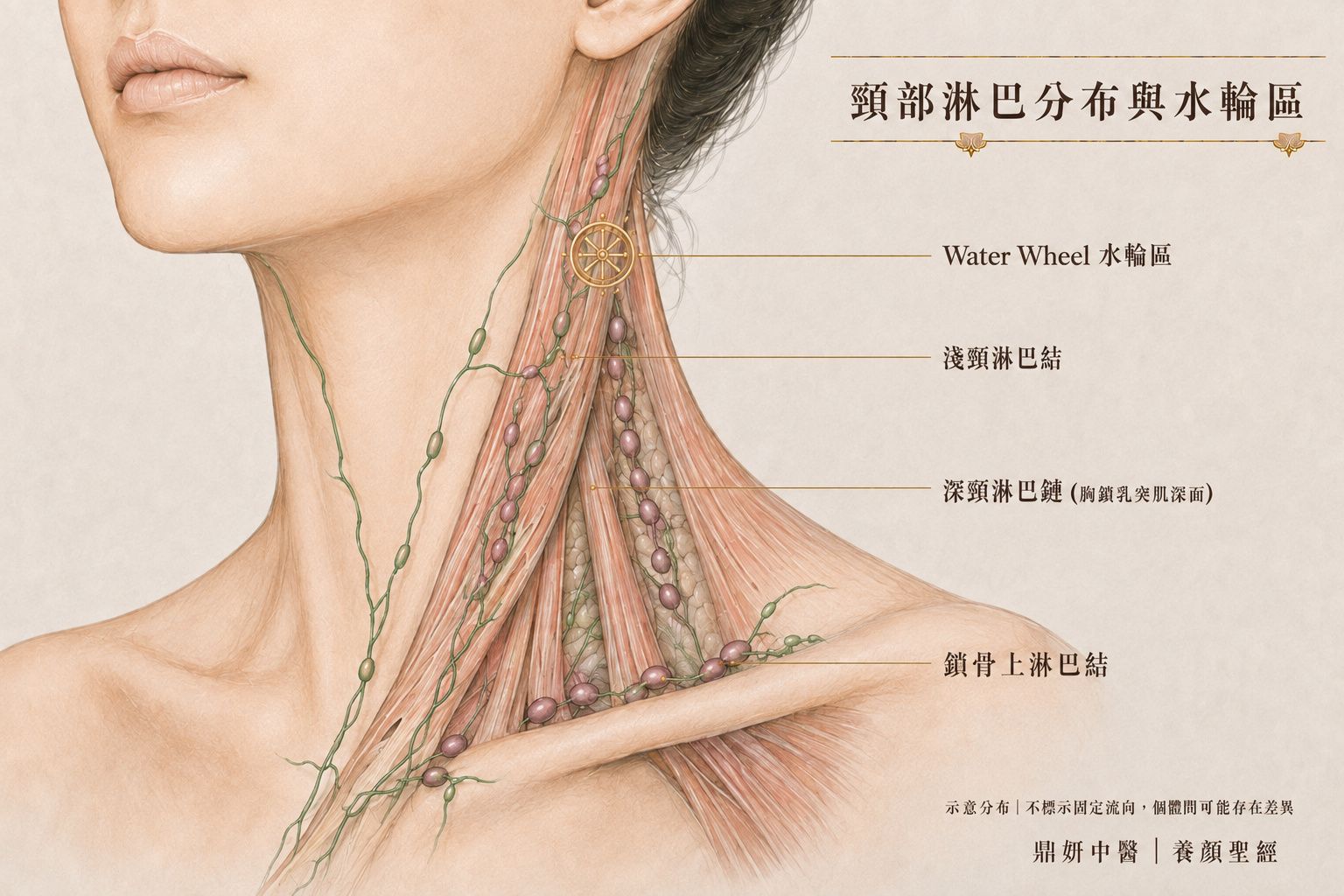
Lymphatic vessels are delicate, and effective manual lymphatic work is characteristically light and rhythmic. The practitioner considers regional anatomy and often prepares proximal drainage areas before guiding more distal fluid. Pressing hard on a swollen face is not the defining feature of lymphatic drainage.
Direction comes before pressure
If downstream pathways are restricted, repeatedly pushing the face may offer only transient comfort or may increase irritation. Assessment should consider the neck, clavicular region, breathing, recent procedures, inflammation and the character of swelling.
Anatomy Trains: local appearance, whole-body tension
The Anatomy Trains model describes myofascial continuities that help clinicians think beyond an isolated muscle. It can be useful when facial tension appears connected with the jaw, neck, chest, breathing or posture. The model is a framework for assessment, not proof that every facial concern begins elsewhere in the body.
Why fascia and lymph are not separate issues
Lymphatic vessels travel through connective tissue environments. Inflammation, scar history, muscle tension and restricted movement can influence tissue comfort and fluid behavior. Conversely, swelling can make tissue feel heavy and less mobile.

A thoughtful clinical sequence
A session may begin by observing breathing, neck movement and tissue quality. Proximal areas are prepared when appropriate, then lighter facial work follows along relevant pathways. Fascial restriction may be addressed without abandoning lymphatic direction or using excessive force.
When massage is not appropriate
New one-sided swelling, redness, heat, fever, severe pain, suspected infection, trauma, neurological symptoms or unexplained lumps require medical assessment. Recent surgery, injection or energy-based procedures also change what is safe and when.
How Dingyan integrates these methods
Manual work at Dingyan is used as clinical preparation within a larger facial acupuncture plan. The purpose is not to make every face temporarily smaller. It is to understand fluid load, tissue glide and tension so that the subsequent treatment sequence is more precise.
Continue reading
Begin with an individual assessment
Every face has a different structure, treatment history and health context. A considered plan begins with understanding yours.
BOOK A CONSULTATIONMedical notice: This article is for health education only. It does not provide a diagnosis or replace individualized medical care. Results and appropriate treatment plans vary by person.