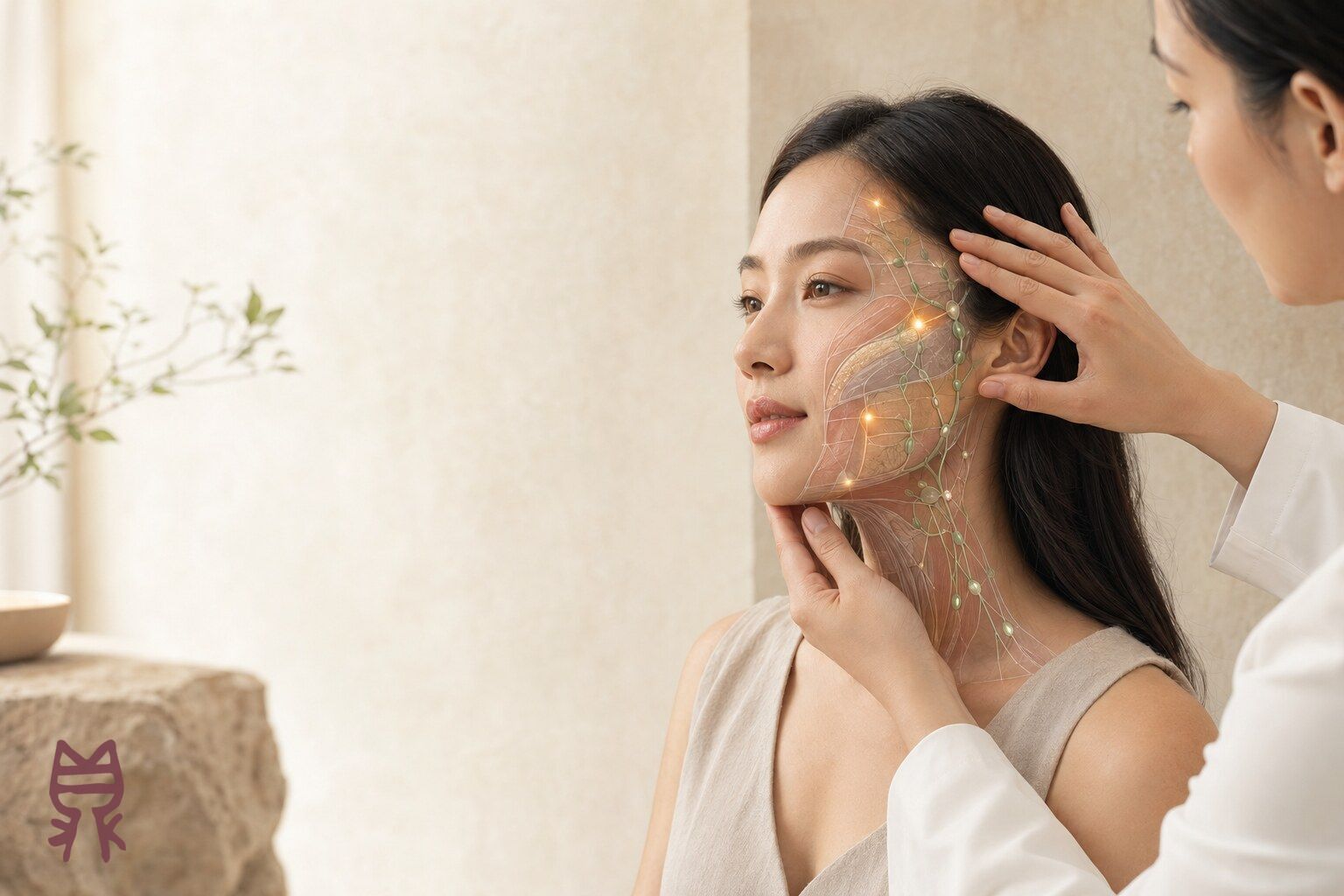
AESTHETIC TREATMENT COMPARISON · THREAD LIFTS
Thread treatments vary in material, length, anchoring and purpose. Lifting threads, short collagen-stimulating threads and body-contouring threads should not be grouped together, and a double chin is not automatically a thread problem.
Different threads, different jobs
Barbed lifting threads mechanically reposition selected tissues. Short smooth threads are often used for local stimulation, while other thread systems are designed for body contouring. Placement plane and direction are central to both effect and risk.
What a thread lift can change
Threads may provide modest, temporary repositioning in a suitable face. They do not remove excess skin, rebuild bone support or correct every form of lower-face heaviness, and results vary with anatomy and tissue quality.
Why a double chin needs assessment first
Submental fullness may reflect fat, a small or retruded jaw, skin laxity, platysma pull, posture, swelling or neck anatomy. A thread cannot solve all of these mechanisms simply by being placed beneath the chin.
Neck tension and downward pull
Forward-head posture, shallow breathing, jaw clenching and tension through the platysma and chest can blur the jaw-neck angle. Treating functional tension may improve comfort and contour clarity, but it does not substitute for structural lifting.
How facial acupuncture differs
Facial acupuncture does not anchor or mechanically suspend tissue. It may address muscle tone, fascia, circulation and connected head-neck patterns while preserving movement.
Timing after thread placement
Newly placed threads require stable healing. Needling, stretching or vigorous massage near the pathway may increase bruising, inflammation or displacement risk. Treatment timing must follow thread type, area, date, recovery and the placing clinician’s instructions.
Possible complications and limits
Bruising, swelling, tenderness, dimpling and asymmetry may occur; infection, extrusion, nerve irritation or vascular injury are less common but important. Persistent pain, redness, discharge, fever or visible thread exposure needs medical assessment.
Choosing between options
Choose by mechanism and acceptable risk rather than by the word “lifting.” Ask what tissue is being changed, how long the result may last, what recovery involves and what happens if the outcome is uneven.
Previous thread maps and dates should be disclosed before facial acupuncture or manual treatment.
Continue reading
Begin with an individual assessment
Every face has a different structure, treatment history and health context. A considered plan begins with understanding yours.
BOOK A CONSULTATIONMedical notice: This article is for health education only. It does not provide a diagnosis or replace individualized medical care. Results and appropriate treatment plans vary by person.