
BEAUTY BIBLE · FACIAL FASCIA
Some people pinch their cheek and feel that the skin and the tissue underneath move independently. When they smile, the surface creases before deeper tissue seems to support the movement. Others lose weight and find that their face looks looser, hollower or more drooped. On Chinese-language social media, these appearances are often grouped under the phrase “skin–soft tissue separation.”
Can facial acupuncture be considered in this situation?
Yes. This appearance does not itself exclude someone from facial acupuncture. The key is to identify how glide, tension and support have changed among the skin, fat, fascia, muscle and tissue fluid, then choose an appropriate approach to unwinding.
An appearance description, not a single diagnosis
The face consists of connected layers: beneath the skin are subcutaneous fat, fibrous septa, the superficial fascial system, expression muscles, deeper fascia and bony support. These layers need both connection and a degree of relative glide. A youthful quality is not about fixing every layer into one rigid unit; it involves the ability to move, support and recoil appropriately.
What is described as “separation” may involve several different factors:
- Reduced skin hydration and elasticity, with a thin, dry or creased surface.
- Changes in fat volume or position, reducing support beneath the skin.
- Restricted glide in fascia and fibrous septa, leaving one area tethered while nearby tissue appears loose.
- Imbalanced tension in expression muscles, chewing muscles, the scalp and neck, creating persistent pulls in different directions.
- Changes in tissue-fluid movement, producing a soft, puffy appearance and less distinct contours.
Whether the skin can be pinched easily is not enough to choose a treatment. Dingyan assesses the resting contour and how the skin and deeper tissue move during smiling, pursing the lips, clenching, swallowing and turning the head.
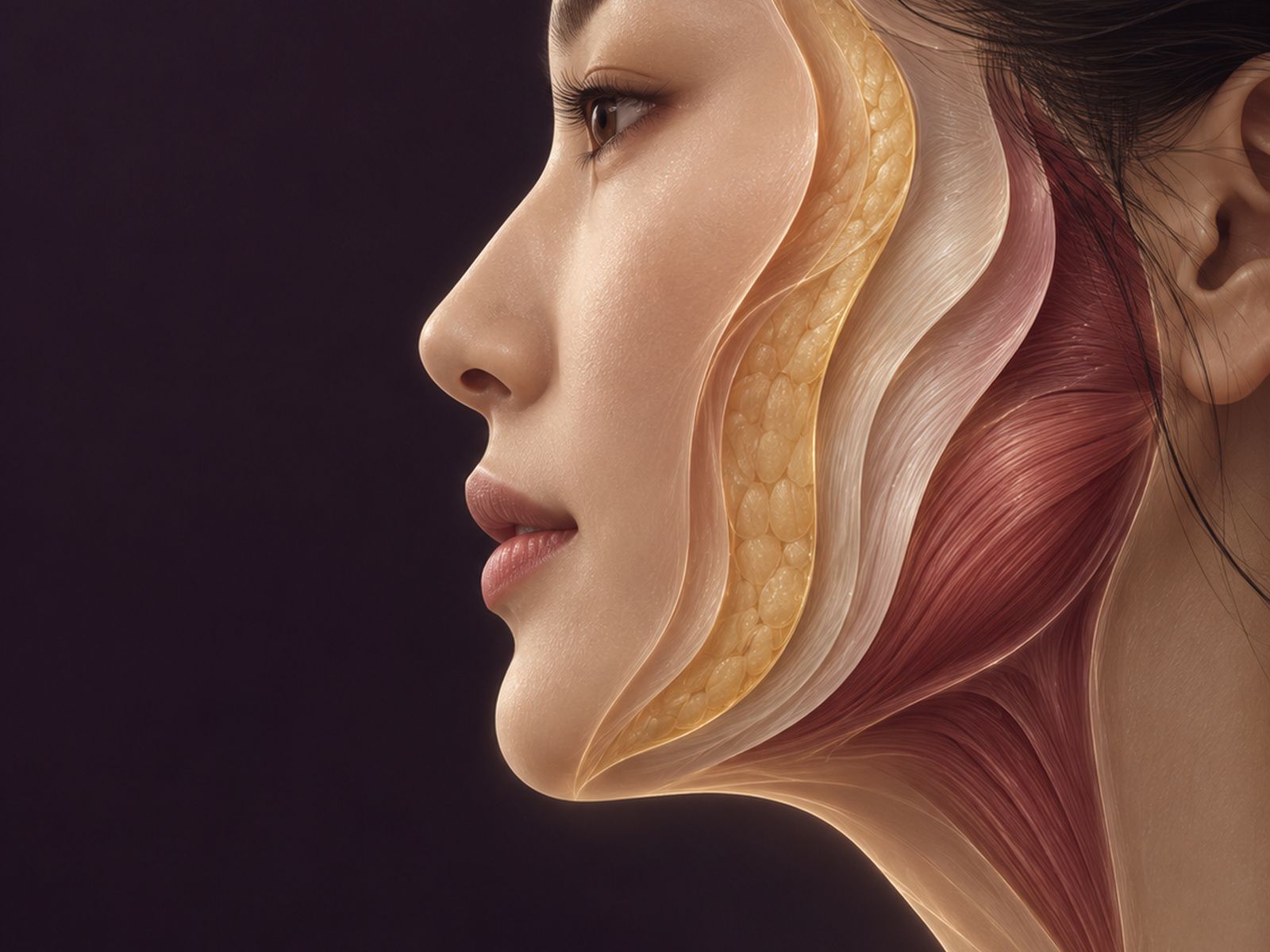
Why can tighter tissue make the face look looser?
A loose appearance does not always arise from laxity alone. It can coexist with excessive tension deeper down. When glide is restricted around the cheekbones, outer masseter, mouth corners, jawline or neck, forces may concentrate at fixed points. Nearby skin and fat may lose even support, creating folds, bulges or a pulling sensation, with tightness in one region and drooping in another.
Imagine fabric stitched down in several unhelpful places. The problem is not necessarily excess fabric. Pulling the whole piece tighter may leave it uneven; releasing the restrictive points and redistributing tension can help it lie more naturally.
Facial acupuncture and the clinical purpose of unwinding
At Dingyan, unwinding does not mean forcibly attaching skin to muscle or roughly prying fascia apart with a needle. Through palpation, dynamic expression and structural assessment, the clinician identifies restricted layers, concentrated pulling forces and areas with reduced support. Facial acupuncture, manual techniques and appropriate supporting methods are then selected to give tissue room to function.
Needles: precise stimulation
Position, depth, direction and sequence are chosen according to tissue thickness, muscle orientation and tension.
Hands: direction and feedback
Fascial release and glide assessment help distinguish which layer has changed and where compensation remains.
Head and neck: a connected assessment
Tension in the scalp, temporalis, chewing muscles, tissues around the hyoid and neck continues to influence facial loading.
Fluid movement: from proximal regions outward
When tissue fluid contributes to the appearance, Dingyan first considers drainage pathways around the lower neck and collarbones before working toward the face.
A more integrated feeling comes from layers that can glide, support one another and return to an appropriate relationship.
Are needles always placed where the face looks loose?
Not necessarily. Visible laxity may be the end result of a broader pattern of tension. For jowls, the starting point may involve midface support, downward pull at the mouth corners, the masseter or platysma. Thin, loose-looking tissue beneath the eyes may coexist with forehead and orbicularis oculi tension, cheek tethering and fluid retention. One side may droop in connection with long-standing clenching and compensation on the other.
Dingyan therefore considers the whole line of force and the relationship between layers, instead of concentrating needles only at the visible problem.
Where do skin care and Chinese medicine fit?
Dry, thin or dehydrated skin can obscure deeper support. Topical skin care supports hydration, suppleness and the skin barrier, helping the surface appear smoother and more luminous. It works at a different level from facial acupuncture and can complement the overall plan.
Chinese medicine considers the bodily conditions that may repeatedly contribute to tension or puffiness. Disrupted sleep, stress-related clenching, changes in digestion or fluid balance, and swelling around menstruation may bring the face back toward a familiar pattern. Herbal treatment, when appropriate, is selected after an individualized Chinese medicine assessment.
Deeper layers: facial acupuncture and manual work to address glide, muscle direction and tension.
Surface: skin care to maintain hydration, suppleness and barrier function.
Whole-body context: Chinese medicine assessment of sleep, stress, qi and blood, and fluid rhythms.
Which situations are worth assessing first?
- Looseness or hollowness after weight change, when adding filler volume is not your only interest.
- One area feels tight and another soft, with uneven movement during expression.
- Jowls, nasolabial folds or jawline asymmetry accompanied by clenching, scalp or neck tension.
- Large morning-to-evening changes influenced by puffiness or sleep.
- Previous aesthetic procedures, when you want to understand what can currently be addressed and in what order.
If the main issue is pronounced skin laxity, altered bony support, substantial fat loss or structural descent, the goal should not be described only as “releasing adhesions.” Assessment can identify the adjustable muscle, fascial, fluid and expression components, while other medical approaches may be needed for other layers.
COMING SOON
From a social-media phrase to Unwind Beauty
A popular phrase can be the starting point for understanding a face. The useful next step is recognizing the different tissue stories beneath it: skin quality; fat volume and weight; fascial glide and tension; muscle direction and compensation; and the effects of sleep, breathing, stress and fluid balance.
Dr. Mandy Lin's Unwind Beauty follows these relationships from the face to the scalp, temporomandibular region, neck, shoulders, rib cage and whole body. It explores how an aged appearance may emerge when connected tissues restrict one another and lose their usual mobility.
What kind of book led Alyssa Chia to tell Dr. Lin, “You are a treasure of a doctor”?
Chinese edition scheduled for November 2026 · Chinese edition list price: NT$880
Read the new book previewFrequently Asked Questions
Can facial acupuncture be considered for this appearance?
Yes. It can address potentially modifiable muscle tension, fascial glide, compensation and tissue-fluid factors. The clinician first assesses the main cause and then plans treatment locations and sequence.
Will facial acupuncture make the skin looser?
Properly planned treatment aims to redistribute tension and improve coordination, rather than separate the skin from deeper tissue. The approach is adjusted to tissue thickness, previous procedures and the current condition.
Can fascial adhesions simply be pried apart with a needle?
That is not the approach described here. Unwinding involves palpation, direction, depth, sequence and tissue response, including related scalp, chewing-muscle, neck or more distant tension.
Must skin care or herbal medicine be included?
No. Skin care may support a dry or unstable barrier. Chinese medicine assessment may be considered when recurrent puffiness, clenching or fatigue relates to sleep, stress, digestion or menstrual changes.
What if I have had ultrasound, radiofrequency, fillers or thread lifts?
Start with a clinical assessment and provide the procedure type, treated area and date. The clinician considers whether the tissue has stabilized and which layers and treatment sequence are appropriate.
How many sessions are usually arranged?
Dingyan commonly plans an initial course of one session per week for six sessions, followed by maintenance approximately every three to four weeks. This is adjusted according to the initial assessment and the response at each visit.
Begin by understanding what is holding the tissue.
Dingyan's clinicians assess skin, fat, fascia, muscle, head and neck tension, and puffiness to identify an appropriate starting point.
Explore facial acupuncture · Contact Dingyan on LINEPrepared from Dr. Mandy Lin's clinical observations for education about facial structure and facial acupuncture. Individual circumstances require assessment by a qualified clinician.
By Dr. Mandy Lin · Founder of Dingyan · Dingyan Method
Chinese source: 2026-09-07 · Translation published September 19, 2026.